
Ranchly.
A multi-tenant farm management platform tracking production, stock, feed, and sales across role-gated organizations — built solo across backend, frontend, and database.
- Role
- Lead Full-Stack Developer
- Year
- 2026 — Present
- Sector
- Agriculture / AgTech
- Status
- Live
Stack
Overview
Ranchly is a multi-tenant farm management platform. Each organization — a farm — runs its own isolated operation: tracking livestock production and stock movements, managing feed inventory, recording sales, and reporting on all of it, with super admins overseeing the platform across every organization. I'm building it end-to-end, solo — the backend, the database, and the frontend.
One codebase, species-agnostic by design — a farm raising chickens and a farm raising goats run on the same schema.
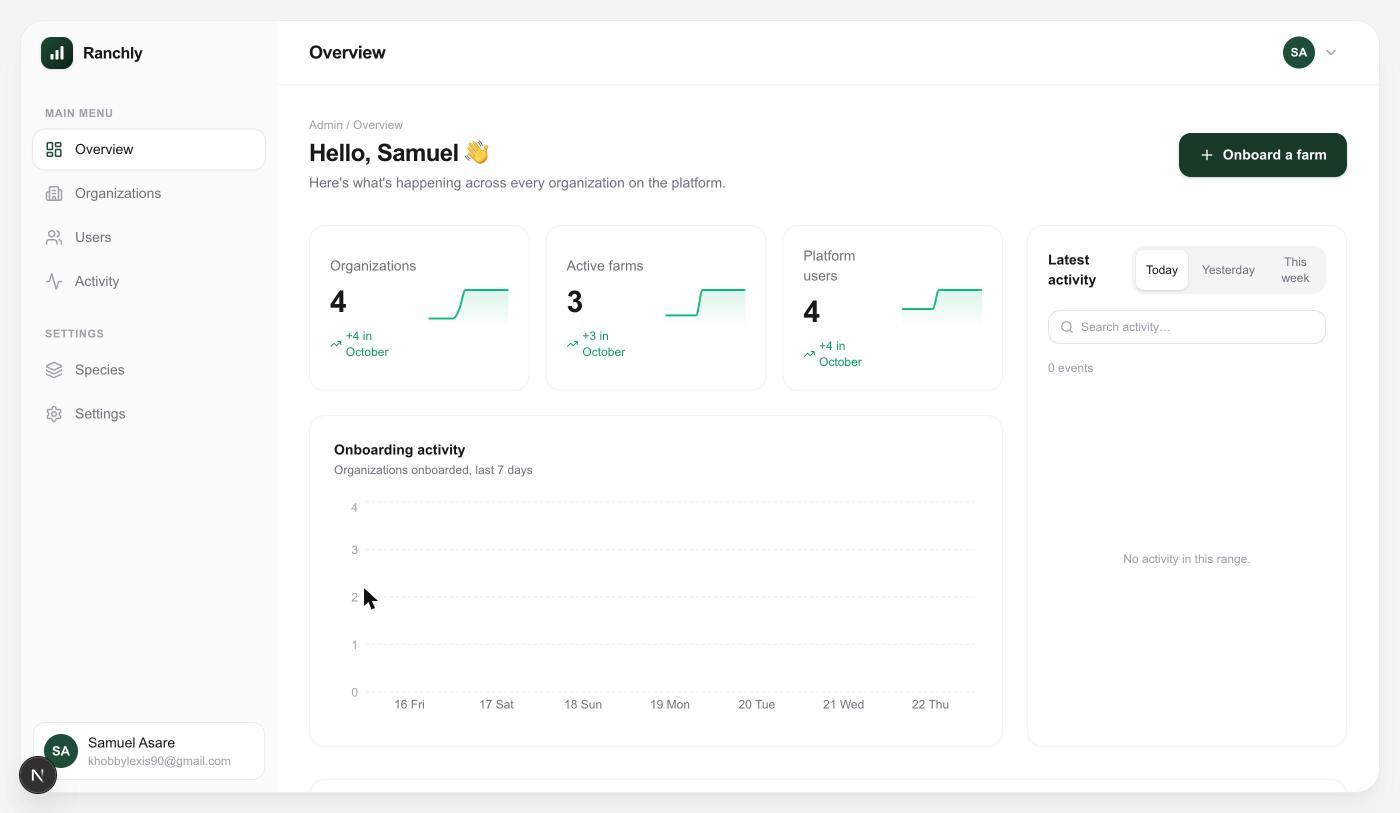 Ranchly super admin overview — organizations, active farms, and platform users
The platform started as a poultry-specific tool and was generalized early: species — the animal or product a farm raises — is a configurable entity per organization rather than something hardcoded, so the data model and the UI scale to any kind of livestock operation without a rewrite.
The problem
Small farm operations often track production, feed costs, and sales across notebooks, spreadsheets, and memory — with no single source of truth for what's in stock, what's been sold, or when feed is about to run out. Multi-location or multi-staff farms add another layer: owners need visibility into what managers are doing without micromanaging every entry themselves.
Ranchly centralizes that into one role-aware system, built so a farm admin can see everything a manager records, and a platform admin can manage onboarding and access across every farm on the platform.
What it does
Every organization gets an isolated workspace with three access levels: super admins (platform-wide, manage organizations, species, and users), farm admins, and farm managers, brought on board through an invite-code flow rather than open signup.
For managers running day-to-day operations: logging production entries, recording stock movements (arrivals, mortality, sales) by species, tracking feed purchases and consumption against configurable reorder thresholds, and recording sales against customers and per-product pricing.
For farm admins: the same operational tools plus customer and pricing management, an activity log of what's happened across the farm, and CSV/PDF export for sales and production reports.
For super admins: onboarding and managing organizations, defining the species available platform-wide, and managing users across every farm.
Running in the background, a scheduled job checks every feed type against its reorder threshold and projected daily usage, and emails farm admins a low-stock alert — with enough lead time to reorder before they actually run out.
What makes it interesting
- Species-agnostic from the schema up. Species, units, and sub-units are configurable per organization, not hardcoded — the same tables that model egg production for a poultry farm model milk yield for a dairy farm.
- Projected alerts, not just threshold alerts. The feed reorder system doesn't just fire when stock is low — it estimates days remaining from a daily usage rate and warns ahead of the threshold, with a cooldown so admins aren't spammed.
- Invite-gated onboarding. No open signup — every farm admin and manager joins through a coded invite tied to a specific organization and role, keeping multi-tenant data properly scoped from day one.
- Soft-deletable organizations. Deactivating or removing a farm locks its members out through a dedicated "account unavailable" state rather than silently breaking their session.
What I'm taking away so far
- Generalizing a domain model early — before locking into "poultry" — saved a rewrite once the product direction broadened to any livestock type.
- A good alert isn't "you're out," it's "you will be out in three days" — projection beats threshold when the cost of running out is operational, not just inconvenient.
- Gating signup behind invites is a small decision with outsized effect on multi-tenant data integrity — it closes off an entire class of bugs around who can join which organization.
Links
Next project
Paynest
A full-stack, multi-tenant cloud POS system with barcode-driven checkout, dual-channel notifications, and JWT-blacklisted auth. A solo build across backend, frontend, and database.