
Paynest.
A full-stack, multi-tenant cloud POS system with barcode-driven checkout, dual-channel notifications, and JWT-blacklisted auth. A solo build across backend, frontend, and database.
- Role
- Lead Full-Stack Developer
- Year
- 2025 — Present
- Sector
- Fintech / Retail
- Status
- Live
Stack
Overview
Paynest is a cloud point-of-sale platform for small and mid-sized businesses in Ghana. It's a single place to run sales, track inventory, manage orders, close out the day, and report on everything — designed around the workflows, currency, and payment methods of local retail and restaurant teams.
I built this end-to-end as a solo project — the backend, the database, and the frontend — because I wanted to understand what it actually takes to ship a real, multi-user product without relying on other people's building blocks.
One person, two sides of the stack, full ownership — from database schema to receipt-printer layout.
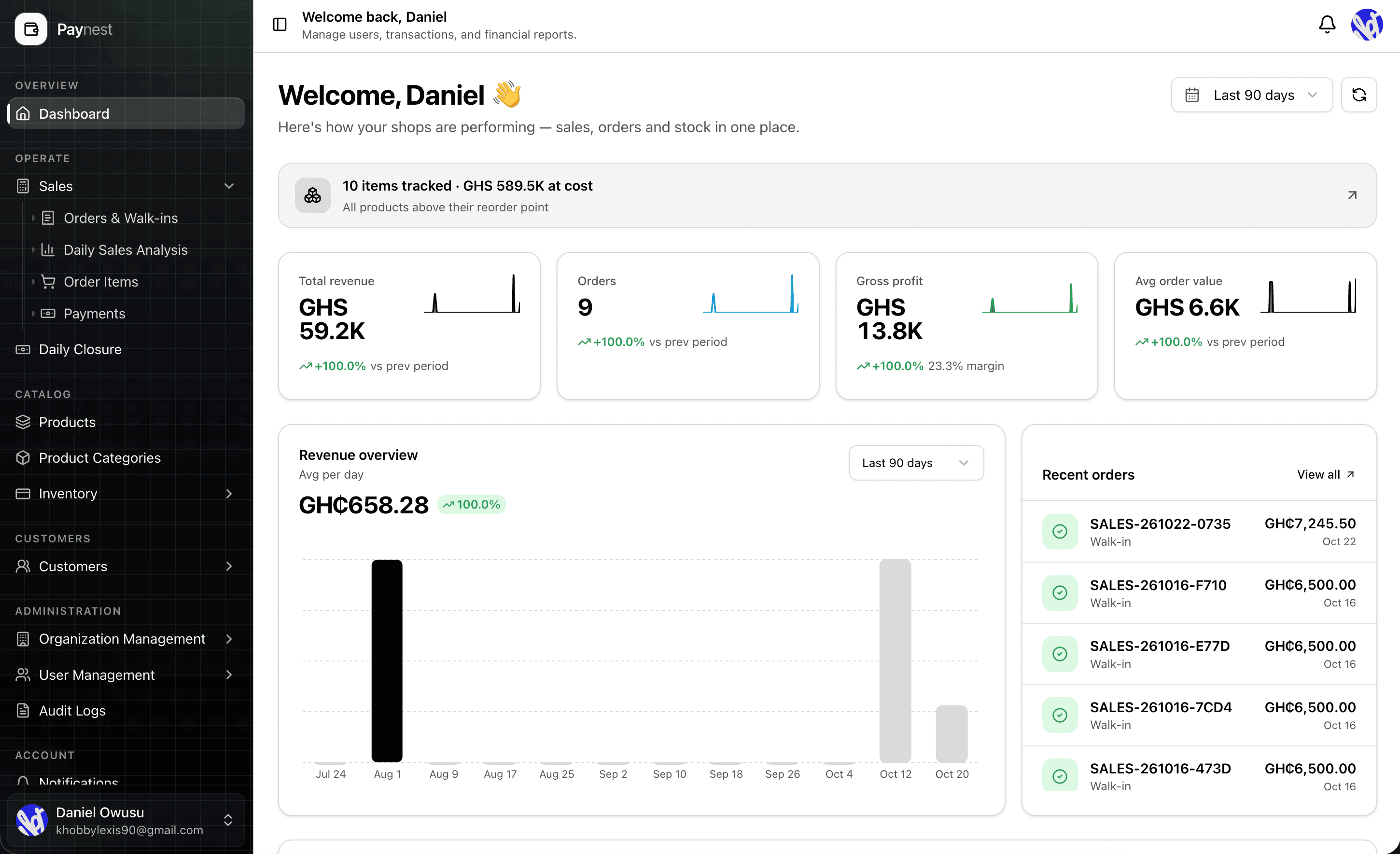 Paynest admin dashboard — revenue, orders, and gross profit at a glance
The problem
Small and mid-sized retail and restaurant businesses in Ghana often run on a patchwork of disconnected tools: a spreadsheet for inventory, paper receipts for sales, a notebook for customer records, and nothing that pulls it together at the end of the day. Existing POS systems tend to be expensive, locked to specific hardware, or designed around foreign currencies and workflows.
Paynest is my attempt at something that fits the Ghanaian context — cloud-first, mobile-money aware, GHS-native, and priced to make sense for a local business.
What it does
Every business that signs up gets its own isolated workspace with four levels of access: superadmins, admins, managers, and attendants. Everyone sees only what's relevant to their role.
For the attendant running the till: a fast checkout that supports barcode scanning (camera or USB), walk-in sales, takeaway orders, cash, bank transfer, and mobile money payments, and printable receipts straight from the browser.
For managers and admins: inventory and shop-level stock tracking, a full audit trail of stock movement, alerts when things run low, and a daily closure workflow so nothing slips through the cracks at the end of the day.
For ownership: reports. Sales, financials, employee performance, inventory, customer analytics — generated as PDF, Excel, CSV, or JSON with an approval workflow and an in-app preview before anything is downloaded.
And running across everything, a notification system so the right person hears about the right thing — new orders, low stock, approved reports, closure reminders — in-app or by email, with per-user preferences for both channels.
What makes it interesting
- Solo, end-to-end. Database schema to receipt-printer layout, one person, one codebase — the kind of scope where you learn what a product actually needs.
- Designed around the Ghanaian context. Mobile money is a payment method, not an afterthought. GHS is the default everywhere. Business roles map to how local teams actually operate.
- Real authentication, not a tutorial version. Logout actually revokes the session, password changes kill old logins, and sensitive endpoints are rate-limited — the details that separate "works in development" from "safe to run."
- Notifications are a feature, not a checkbox. Users decide what they want to hear about and how, and everything that happens in the system knows how to reach the right person.
What I took away
- Shipping end-to-end is the best way to learn what a product really needs. Every subsystem looks simple in isolation until you own the whole pipeline.
- A clean data layer pays compound interest — once the shape of the API is consistent, new features turn into short jobs instead of long ones.
- Notifications, inventory, and daily closures are all features users don't think about until they're wrong. Getting them right is most of what product quality actually is.
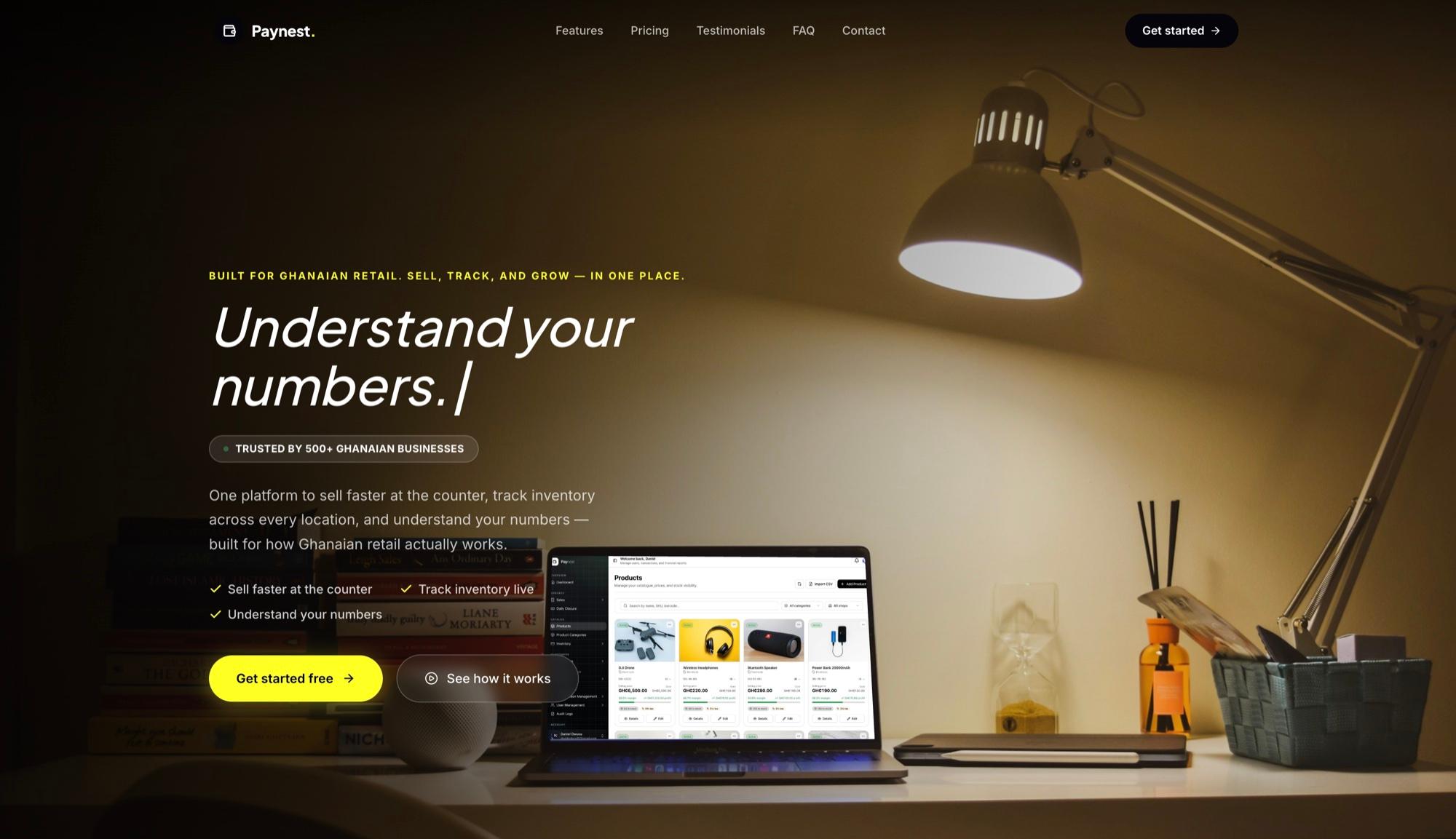 Paynest marketing site — "Understand your numbers."
Links
Next project
LearningBrix
A production-grade, multi-tenant K–12 platform digitizing school operations across academics, finance, payroll, and library from a single permission-gated web app.