
Carfetcha.
A full-featured car rental and sales marketplace for the Ghanaian market, serving customers, suppliers, and admins from three complete role-based experiences with no functionality left mocked.
- Role
- Frontend Engineer
- Year
- 2026
- Sector
- Automotive / Marketplace
- Status
- Live
Stack
Overview
Carfetcha is a car rental and sales marketplace built for the Ghanaian market. Customers browse, rent, or buy vehicles; suppliers list and manage their fleet; admins run the whole platform. I built it as the production frontend against a real FastAPI backend, with three complete role-based experiences and no functionality left mocked.
Three roles, one booking engine, one chat system — no near-duplicate pages hiding behind them.
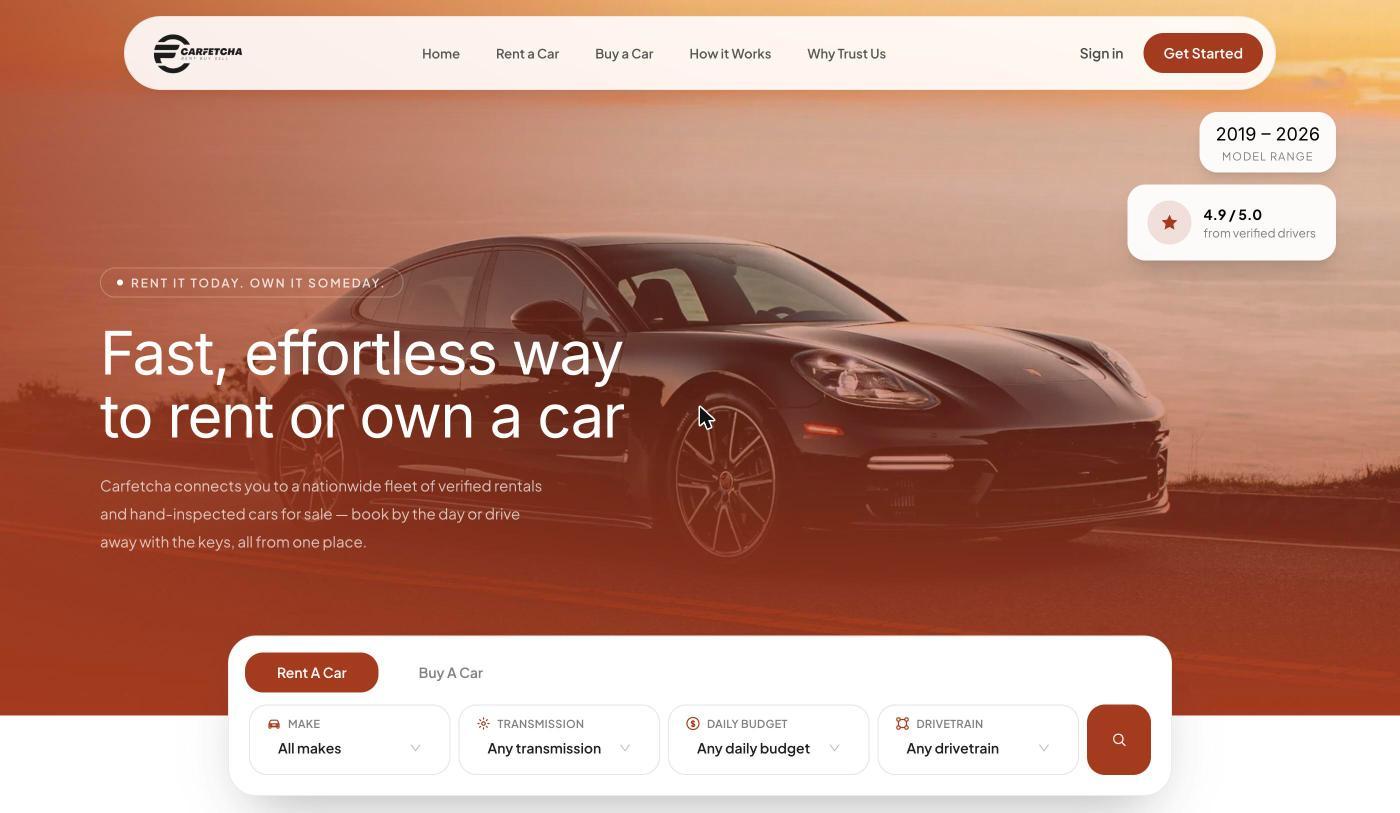 Carfetcha homepage — rent or buy search, live from carfetcha.com
What it does
For customers: a full listings browser with search, sort, and filter synced to the URL, listing detail pages with an image gallery and priced add-ons, and a rent-or-buy booking flow covering date selection, pickup/drop-off, insurance, delivery, full-payment or installment plans with a live cost estimate, trade-in valuation, extensions, and cancellations — all backed by an off-app payment model where a submitted reference gets admin-confirmed.
For suppliers: listing management (create, edit, deactivate, delete), booking oversight, installment and extension queues, and transaction history.
For admins: platform-wide analytics, a listing approval queue, user management, supplier invitations, dispute resolution, and a generic content manager driving four public content types (FAQ, articles, testimonials, brand logos) from one shared field schema.
Running underneath all three roles is a WebSocket-based chat scoped to each booking, with auto-reconnect and graceful handling of terminal disconnects — admins can watch any conversation live but can't send messages, enforced on both the backend and the UI.
What makes it interesting
- One booking page, three roles. A single component renders installments, extensions, chat, disputes, and activity, with role-conditional action panels instead of three near-duplicate pages.
- Shared, parameterized components over duplication. One
ListingFormhandles create and edit for both supplier and admin; oneListingDetailViewrenders the view page for both roles with role-gated actions; oneContentTypeManagerdrives four unrelated admin CRUD screens from a declarative schema. - Resilient against an evolving backend. Every phase was cross-checked against the backend's live OpenAPI schema, not just its docs — catching real discrepancies before they became bugs.
- Honest price estimation. Client-side cost previews only ever compute from values the API actually returns; fields the backend prices server-side (like insurance and delivery) are never guessed at, so a customer's estimate can't silently drift from what they're actually charged.
- Role-based routing at the edge. A proxy layer reads the signed-in role from a cookie and redirects unauthenticated or wrong-role requests before a single component renders, backed by an Axios client that handles Bearer-token attachment and single-flight refresh-and-retry on 401.
What I took away
- Designing one universal detail page that serves three roles cleanly is harder — and more worth it — than it looks; the discipline pays off every time a feature needs to reach all three.
- Treating a backend's live OpenAPI schema as the source of truth, not its documentation, catches the discrepancies that actually break a build.
- Never estimate what you can't verify: a price preview is only trustworthy if every number in it traces back to something the API actually returned.
Links
Next project
Kocha
A role-based mentorship platform with real-time chat, structured programs, and a data-driven navigation resolver serving three distinct user types from a single application shell.