
AccraBeds.
Real-time digital infrastructure giving ambulance dispatchers, families, and walk-in patients instant visibility into hospital emergency bed availability across Accra.
- Role
- Lead Frontend Engineer
- Year
- 2026
- Sector
- Healthcare
- Status
- Live
Stack
Overview
AccraBeds is a digital infrastructure solution that provides real-time visibility into hospital emergency bed availability across Accra, Ghana. The platform enables hospitals to report bed capacity updates while allowing the public, ambulance services, and healthcare providers to quickly identify hospitals with available beds.
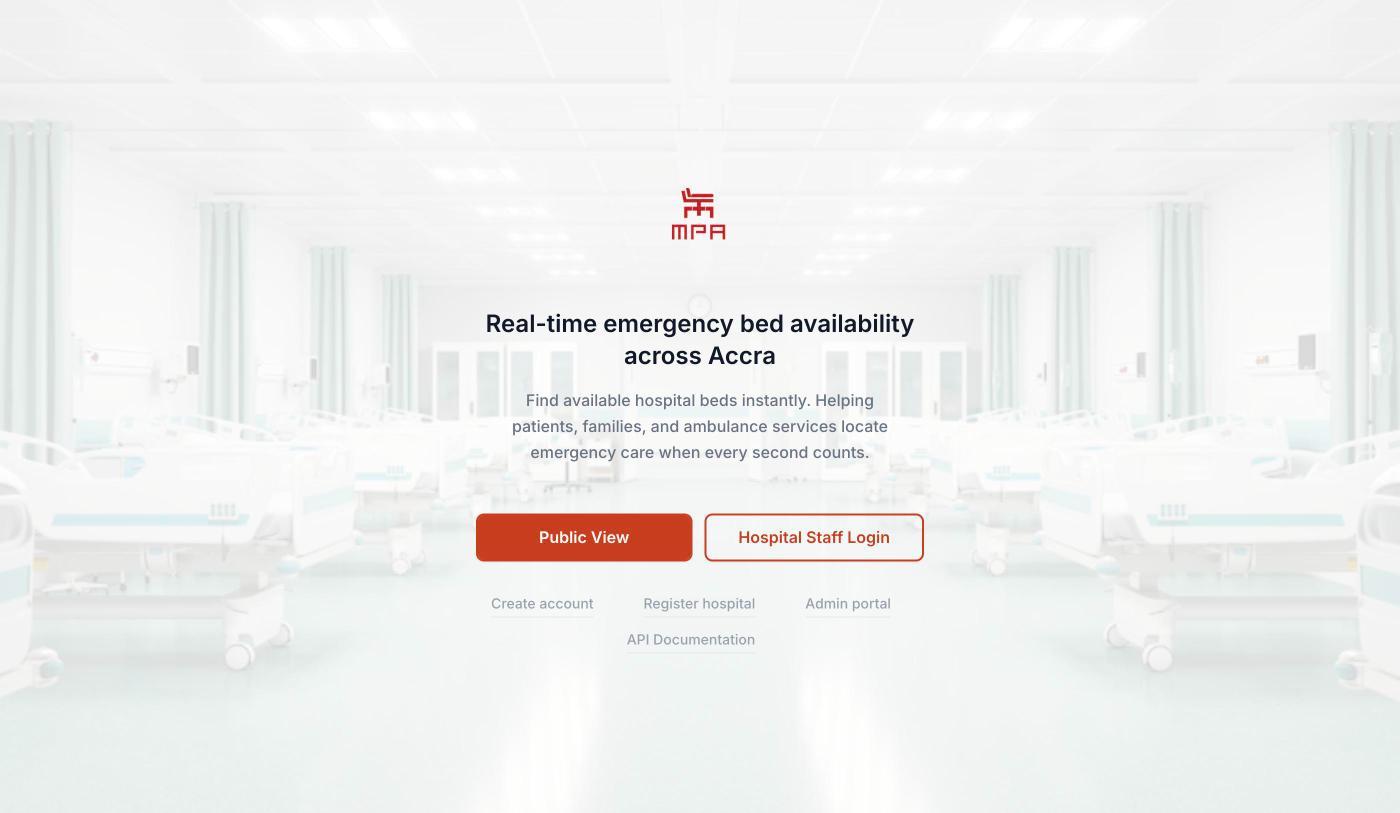 AccraBeds landing page
The problem
Emergency patients in Accra often face delays because hospitals lack visibility into bed availability across the city. Patients and ambulances frequently travel between hospitals searching for capacity, resulting in lost time during critical situations.
Problems addressed:
- Lack of real-time visibility into hospital capacity
- Ambulances frequently redirect between hospitals
- Emergency departments become overcrowded unevenly
- Patients and families lose valuable time searching for available care
"23 beds available" is only as trustworthy as its timestamp. Staleness is a first-class signal in healthcare data.
What I built
Three connected experiences sharing one frontend:
- A public search and map for finding beds by location, category, and distance — with a live map view, filters, and a stale-data warning so no one trusts information that's more than 30 minutes old.
- A hospital staff dashboard where matrons keep bed counts current, manage categories, review their update history, and see platform announcements.
- An admin console for the platform operators — approving hospitals, managing users, publishing announcements, and reviewing system health and analytics.
Secure sign-in with two-factor authentication for staff and admins, a role-aware experience for each user type, and an analytics view showing hourly availability, capacity trends, response times, and a geographic heatmap of where the city actually has capacity.
What makes it interesting
- Three distinct audiences from one codebase. Dispatchers, matrons, and admins each get a tailored experience without forking the product.
- Trust over speed. Every place the app shows a bed count also shows when it was last updated, and flags data that's gone stale — staleness is treated as first-class information, not an afterthought.
- Built for the real user. Matrons update beds on a phone in a noisy ER. The update flow is three taps: open the card, type the new number, save.
- Fast and light. The analytics charts are drawn from scratch instead of pulling in a chart library — the whole page is crisper and lighter than it would have been with a dependency.
- Ready to grow. All user-facing text lives in one file, so a future Twi, Ga, or Hausa translation is a one-file change.
What I took away
- The hardest user to design for is the one using the product under pressure. The matron's flow went through several iterations before it became something you can use without reading anything.
- When data quality is the whole point of the product, the way you surface freshness matters as much as the data itself.
- Hand-rolling small pieces of the UI is often cheaper than pulling in a library that needs theming to match the rest of the design.
Links
Next project
Harmony
A three-sided influencer marketing platform connecting brands, creators, and administrators in a unified collaborative workspace — with dynamic onboarding and real-time campaign workspaces.